
During renovation projects like my youngest daughter’s room makeover, I’m always glad to have my 3D printer. And when someone has already posted a model online that I can repurpose, that’s even better.
One small problem I ran into during the renovation was how to get the network cable connected to my daughter’s computer. There’s been a network cable with an RJ45 plug lying unused under the skirting board in that room for 15 years. Of course, that cable isn’t long enough to reach directly to the computer across the room. I needed a coupler or a socket. I didn’t have a network socket lying around, and I really didn’t feel like cutting off the RJ45 plug and rewiring everything.
But what I do have are RJ45 keystone modules, and what did I find on Printables? An angled keystone mount, actually designed for drywall, but why shouldn’t it work in my homemade skirting boards?
https://www.printables.com/model/1353127-minimalistic-rj45-angled-ethernet-wall-plate
I should mention: my skirting boards are made from the laminate flooring itself (wooden battens on the wall, cut laminate to size, a board on top, another in front, and a plastic trim on top) because the heating pipes need to be hidden behind them.
So, I printed an adapter on my 3D printer, drilled/sawed a matching hole in the top laminate board, and then mounted the adapter.
This is what it looks like in the end:
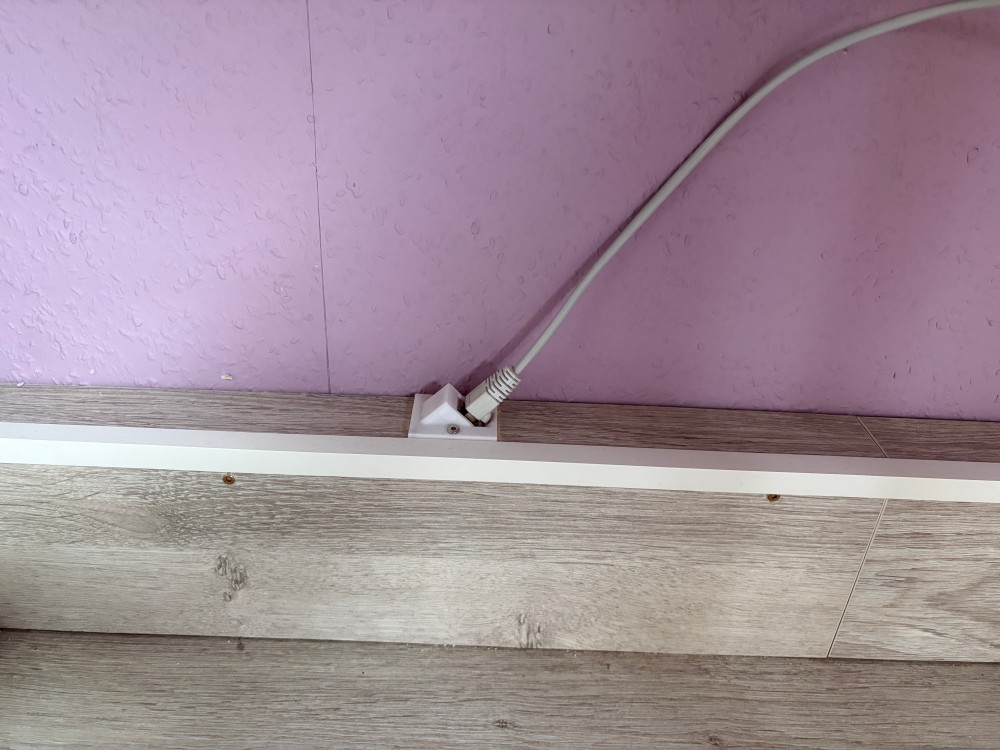
For me, it does the job, and maybe sooner or later the cable will disappear into a small cable duct.